


The honest answer, straight to the point:
We’ve started.
But we’re slow. And we move back and forth.
If the energy transition is a marathon, Indonesia is already wearing running shoes and a cool outfit, but we still keep stopping to debate whether we’re running toward the stadium or just hanging out at the park.
The targets are there, though.
The government aims for renewables to reach 23% of the national energy mix by 2025, and around 31% by 2050. We’ve committed to cutting emissions through our NDC (Nationally Determined Contribution) and signed the Paris Agreement.
Globally, Indonesia is even part of major schemes like the Just Energy Transition Partnership (JETP) — up to US$20 billion in funding to accelerate coal plant retirement and expand clean energy.

Source: IESR Energy Outlook 2025
On paper?
It looks very serious, bestie.
But the reality on the ground… hits a little different.
So What’s the Actual Situation?
Coal is still the main character. Still running the show.
Data from the Ministry of Energy shows that as of 2022, Indonesia’s total installed power capacity was about 81.2 GW. More than half of that—42.1 GW (51.8%)—comes from coal-fired power plants.
Meaning? More than half of our daily lives are literally powered by coal.
And that’s not all.
Other fossil fuels like gas and diesel also hold big portions.
Gas-based plants account for about 21.6 GW.
Diesel adds another 5 GW.
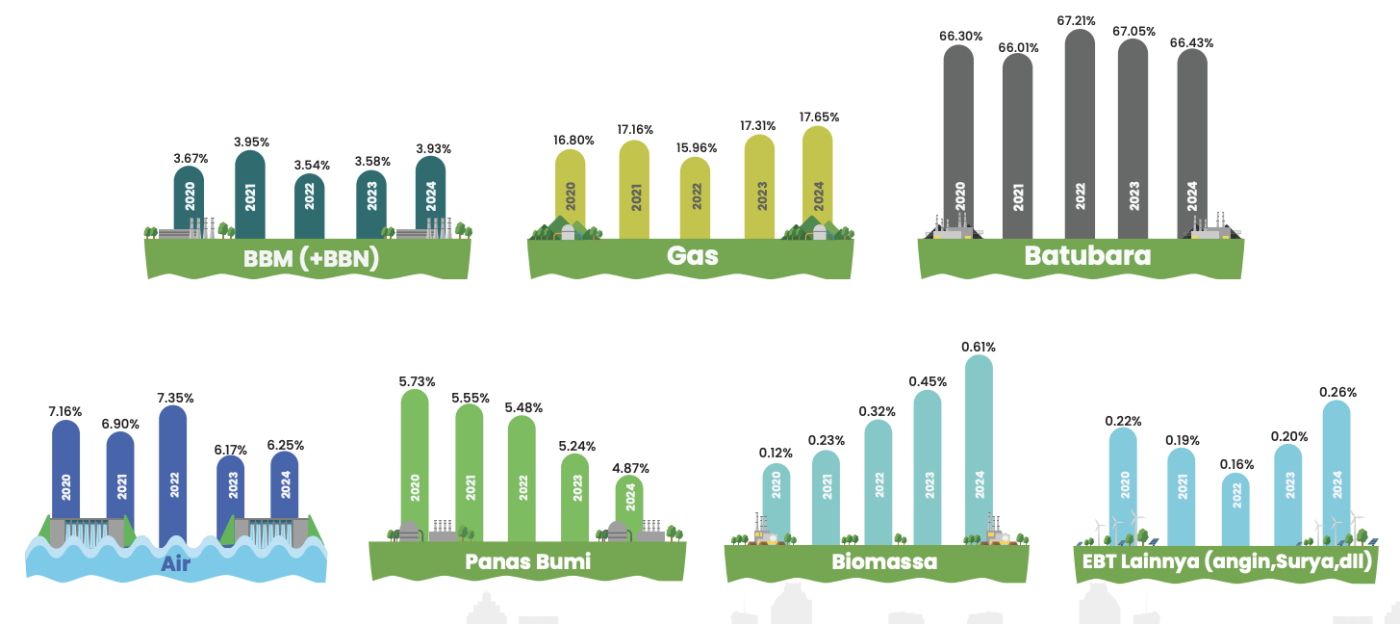
Source: Kementerian ESDM 2024
And over the last five years, fossil capacity has still been increasing.
Meanwhile, renewables?
Yes, they’re growing. But barely.
2021: 11.5 GW
2022: 12.6 GW
The percentage? From 15% to 15.5%.
That’s a 0.5% jump. Paper-thin.
So in simple terms: More than half of our electricity still comes from coal.
Clean energy hasn’t even reached one-fifth.
And It’s Not Just About Numbers
Coal plants aren’t just electricity machines.
They also:
- Contribute to air pollution → increasing risks of respiratory and heart diseases
- Leave behind abandoned mining pits that have taken lives, including children
- Worsen the climate crisis
So the real question is:
Is this sustainable development? or a toxic relationship?
Because the vibe is very much: “It hurts us, but we’re not ready to let go.”
It gets even more awkward when we talk about “energy transition” like we’ve already moved on, when in reality, we’re still living with the most problematic ex.
Sad But True
Coal plants are still being built. Contracts are long-term. Many are designed to operate for decades.
What does that mean?
Even though we talk about transition, the old system hasn’t truly been left behind.
We’re standing with two feet in different places:
One foot wants to shift. The other is still comfortable in fossil fuels.
And when other countries start halting new coal projects, Indonesia still argues:
“We need the electricity.”
“It’s cheap.”
“It’s reliable.”
But cheap for whom?
Because this “cheap” electricity often ignores hidden costs: healthcare bills from pollution-related illnesses, environmental damage, and long-term climate burdens.
Massive Potential, Minimal Realization
This is the frustrating part.
Indonesia has enormous renewable potential, solar, hydro, geothermal, wind, bioenergy. The resources are there.
But what’s actually being utilized is far below the technical potential.
Why?
Changing regulations.
Long permitting processes.
Unattractive pricing schemes.
A highly centralized electricity system. (Ekhem, PLN.)
Many small-scale clean energy projects survive because of community initiatives and NGOs, not because the system makes it easy.
The transition still feels top-down rather than participatory.
Technocratic.
Closed-door meetings.
Policy jargon.
Graphs and macro scenarios.
Meanwhile, young people, local communities, Indigenous groups, and affected residents often arrive last, hear about it later, or are treated as objects of socialization.

Source: Della Syahni/Mongabay
Even though they are the ones who:
- live near power plants,
- live in mining areas,
- or will bear the climate impacts the longest.
As a result, the energy transition can feel distant, elite, and disconnected, even though its consequences are deeply personal and everyday.
So, Are We Falling Behind or Is There Still Hope?
Both.
We’re not yet on a safe path to meet ambitious climate targets. Renewable growth is slow. Coal dependency remains high. Social justice isn’t yet central in energy policy.
But hope is real too:
- Clean technology is getting cheaper.
- Community initiatives are growing.
- Public awareness — especially among young people — is rising.
- Global pressure is increasing.
So the real question is no longer:
“Can Indonesia transition?”
It’s:How fast?
How fair?
And who gets to be part of it?
