

The usual buzz of university life filled the canteen of the Faculty of Mathematics and Natural Sciences (FMIPA) at Universitas Indonesia—known among students as “Dallas.” In one corner, Syarifa Amira sat alone with a five-thousand-rupiah iced tea, her eyes shifting between the crowd and her laptop screen. As a final-year geology student, she was racing to finish her undergraduate thesis.
“I didn’t come to UI Geology to become a miner. I wanted to be a scientist, a researcher. That’s why I chose Geology under FMIPA, not Engineering like in other universities,” she said on a Wednesday afternoon (13/09).
In Indonesia, most geology programs are housed within Faculties of Engineering and emphasize technical skills tied to construction and natural resource extraction. At UI, however, the geology program—established in 2015—is under the science faculty, where students expect a stronger focus on pure geology and scientific inquiry.
But Syarifa found the reality different. The curriculum, she said, still leans toward extractive industries: mining, oil and gas, and geothermal energy.
“Even though it’s under science, most lecturers come from engineering backgrounds. In the end, we’re all directed toward mining jobs with 20-million-rupiah salaries,” she said.
The only course she considered relatively “green” was Disaster Geology. When she asked whether geology careers could be more environmentally friendly, the answers felt discouraging.
“Just try working first,” she recalled a lecturer responding.
Before this interview, Syarifa had never heard the term “green jobs.” Yet she intuitively understood which professions contribute to environmental degradation. Once the concept was explained, she immediately felt drawn to it.
“I’m really interested in green jobs. Honestly, that might have been my reason for choosing geology in the first place,” she said.
Still, interest alone is not enough. Approaching graduation, she feels unprepared to enter the green sector. She believes her university has not equipped her with sufficient interdisciplinary knowledge or practical skills.
“I feel like I don’t have exposure beyond technical geology, limited access, limited networks. It’s difficult,” she admitted.
For her, geology departments should carry responsibility in the climate crisis, not merely producing industry workers, but upholding humanistic and environmental values. “Mining should be an elective track. There should be more environmentally friendly courses,” she concluded.
What Are Green Jobs?
It is common for students like Syarifa to be unfamiliar with the term. While concepts such as the green economy and sustainable development are increasingly discussed in Indonesia, “green jobs” remain less mainstream.
The International Labour Organization (ILO) introduced the concept in 2010, defining green jobs as decent work that contributes to environmental sustainability and restores ecological integrity. Crucially, they must also meet decent work standards—ensuring workers’ rights, social protection, and fair employment conditions.
Dwi Tamara, a researcher at Koaksi Indonesia, explained that green jobs stand on two pillars: environmental sustainability and decent employment.
“Green jobs aren’t just about being green. They stand on two legs–first, promoting environmental sustainability; second, ensuring decent work,” she said (07/08).
They are not limited to renewable energy. Green jobs can exist or be created in agriculture, manufacturing, construction, science, law, and even fashion.
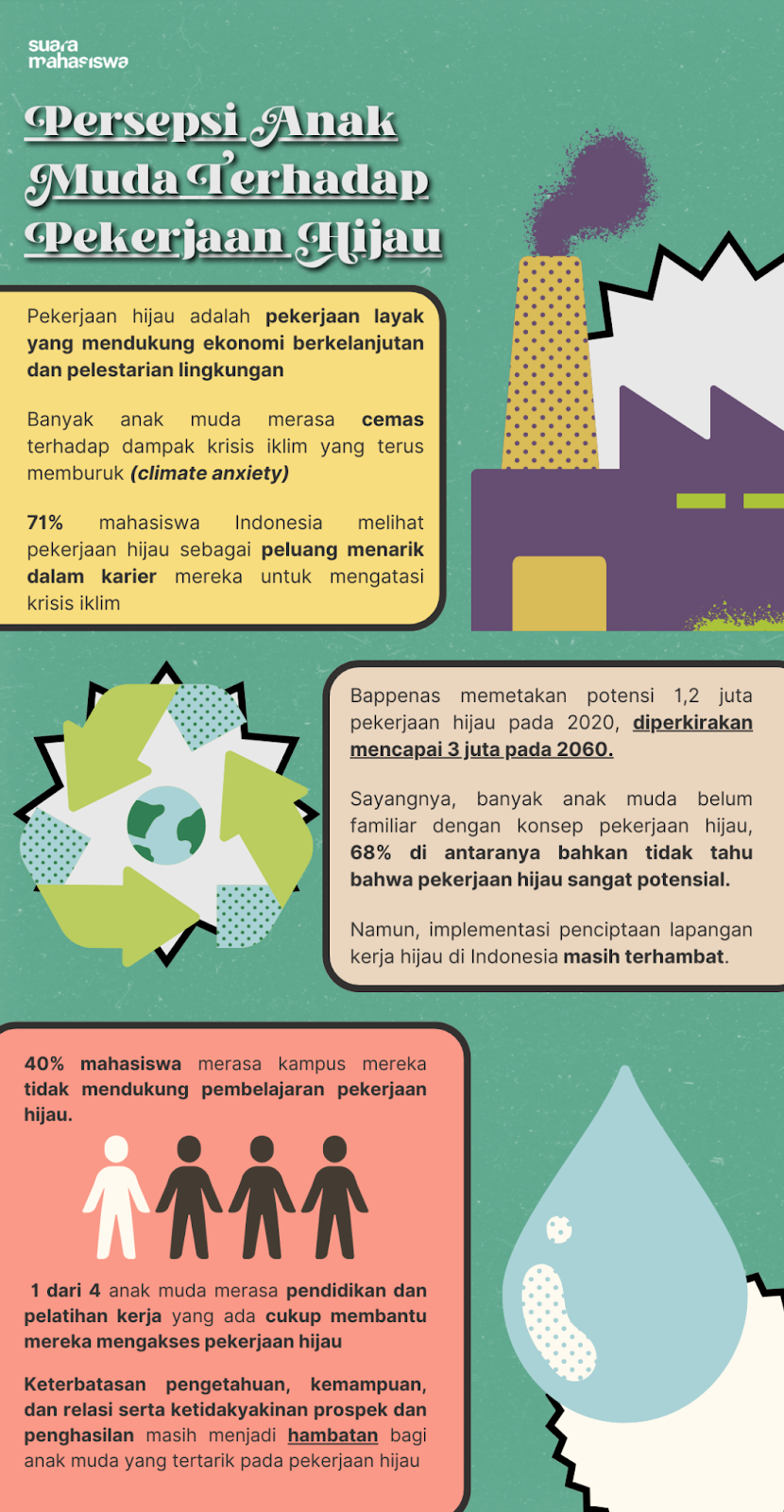
Indonesia has adopted low-carbon development goals. Under a net-zero emission scenario, the National Development Planning Agency (Bappenas) projects that green jobs could grow from 1.2 million in 2020 to 3 million by 2060. Yet concrete strategies to accelerate this transition remain limited.
Youth Aspirations for Sustainable Careers
To understand students’ perceptions of green careers, Suara Mahasiswa UI, in collaboration with Yayasan Indonesia CERAH, surveyed undergraduate and postgraduate students interested in green jobs. The online survey, conducted over 50 days (25 July–12 September 2023), gathered 545 valid responses.
Though not nationally representative, the findings reveal strong trends. Respondents were mostly aged 18–23 (98%), with 65% identifying as female. They came from public (63%) and private (37%) universities.
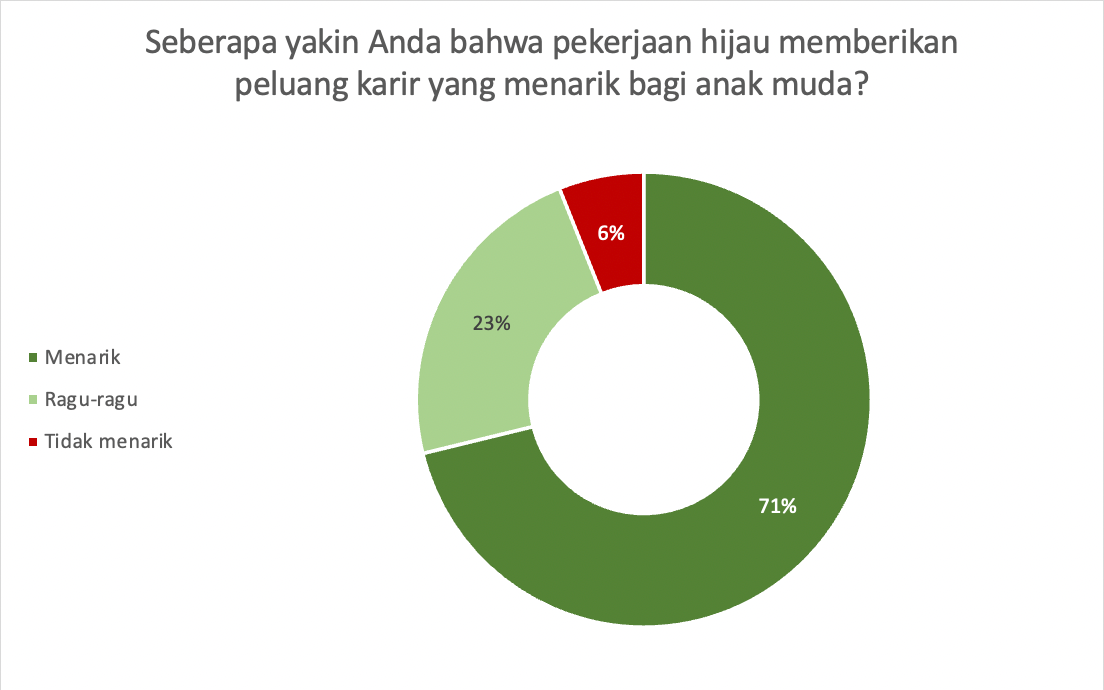
An overwhelming 90% reported anxiety about worsening climate impacts, and 95% agreed the climate crisis requires urgent action. At the same time, 71% viewed green jobs as attractive, and 98% believed they could generate positive social and environmental impacts.
These findings align with global trends. Research by Plan International (2022) shows many young people across Asia, Europe, and the United States aspire to environmentally friendly jobs. A Good Energy survey in the United Kingdom similarly found growing demand for sustainable, decent work.
For youth, green jobs are not just income sources, they are tools for meaningful change. For the state, they offer a double dividend: reducing unemployment while lowering emissions and restoring ecosystems.
“Developing green jobs addresses both employment and environmental issues,” Tamara emphasized.
High Interest, Structural Barriers
Despite strong interest, structural barriers persist.
More than half of respondents (55%) were unfamiliar with the concept of green jobs, and 68% did not know their potential in Indonesia. Among those informed, 72% learned about them through social media. Only 14% received information from universities, and just 0.3% through government outreach.
This gap reflects weak institutional integration.
Fara Shabira Arrasya, who studied in both Indonesia and New Zealand, described stark contrasts. “In Indonesia, I never had a course on the climate crisis. In New Zealand, climate change was discussed extensively—even though my major was Social Welfare,” she said (05/09).
Nearly 40% of respondents said their universities provide no green job-related education or training. Only one in four felt adequately prepared for a green career.
Economic concerns also loom large. Students questioned income prospects (351 respondents), future opportunities (299), and their own competencies (254).
“Economic security becomes the priority, especially in regions dependent on mining and palm oil,” said agriculture student Eko Aditya.
Social perceptions add another barrier. “People still think environmental work doesn’t pay,” said Gamma Maulana Akbar, college student who is interested in waste management entrepreneurship.
Policy Gaps and Transition Challenges
From fiscal and regulatory perspectives, experts argue government support remains insufficient.
Enda Grimonia of Nexus Energy highlighted the lack of strong tax incentives for green businesses. Stronger fiscal policies, she argued, would encourage investment (25/08).
Tamara added that Indonesia lacks a comprehensive legal framework specifically addressing green jobs—crucial for accelerating implementation and incentivizing institutions.
Financial support for sustainable businesses is also limited, often stopping at award programs without long-term backing.
Meanwhile, Indonesia’s continued reliance on fossil fuels complicates transition efforts. A shift to green sectors will inevitably reduce “brown jobs,” making reskilling essential.
“It’s not only about preparing green skills, but also reskilling workers who may lose jobs in fossil fuel industries,” Tamara explained.
Why Green Jobs Matter
Green jobs carry significant potential. Research by Dewi and Ma’ruf (2017) estimated that in 2016, green sectors in energy, agriculture, and forestry generated over 4 million jobs, when national unemployment stood at 7 million.
Indonesia has pledged to reduce greenhouse gas emissions by 29% by 2030 and increase renewable energy to 25% of the national energy mix by 2025. Yet the energy sector still accounts for 46.53% of emissions, followed by transportation (26.39%) and manufacturing and construction (17.75%).
Without adequate green skills, green job growth may stagnate.
“The key is green skills, not just creating or eliminating jobs. Awareness exists, but human resources are not yet sufficient,” Tamara said.
High youth interest must be matched by systemic support. Forty-five percent of respondents feel unsupported, and 39% remain doubtful about institutional backing.
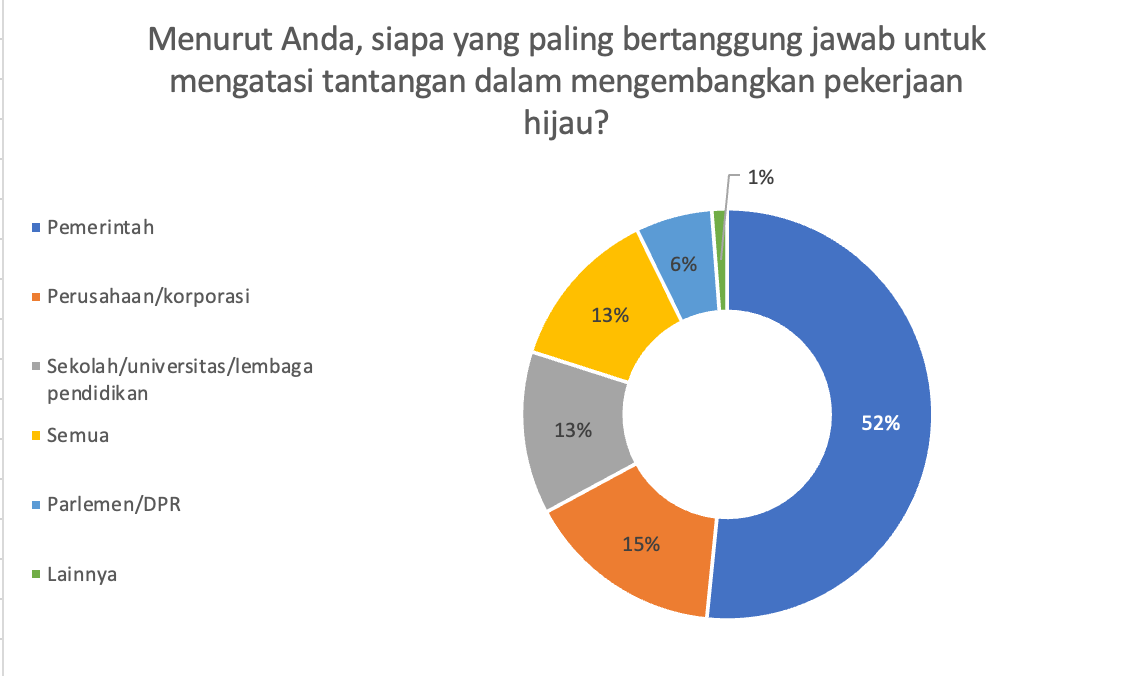
Addressing these gaps requires collaboration among government, private sector, educational institutions, and civil society. Public-private partnerships, internships, and industry-aligned curricula are essential.
Nearly 90% of respondents emphasized integrating climate crisis and green job education into university programs.
“The private sector can offer internships and partner with universities to align skills with industry needs,” Tamara said.
Sustainable education and employment are pillars of a greener future. Overcoming barriers in access, relevance, and recognition of green careers is critical, not only to meet climate targets, but to ensure young people like Syarifa can pursue the meaningful, sustainable work they aspire to do.
Full report was previously published in Suara Mahasiswa UI in 2023.
