

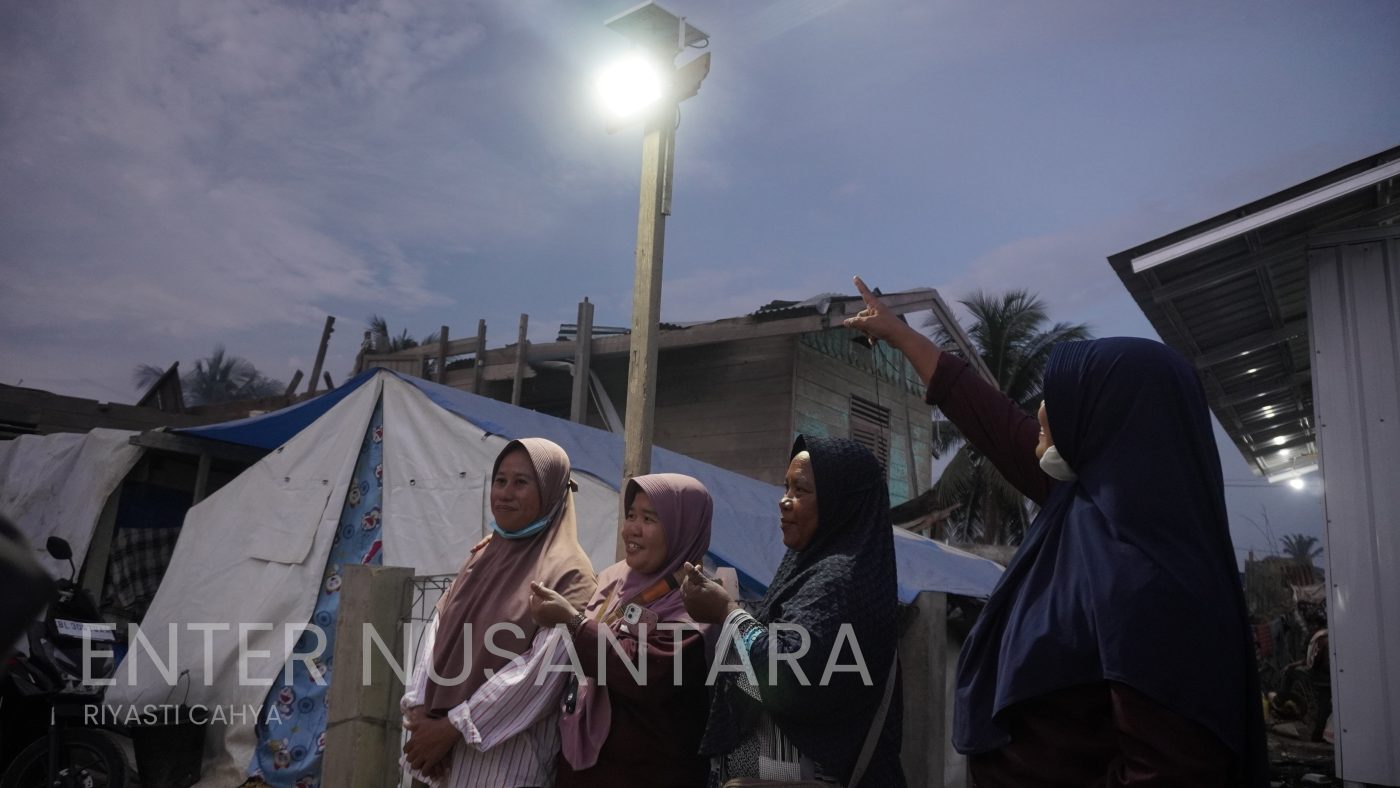
The mud in the remote corners of Aceh may have begun to dry in the memories of many, but the reality on the ground shows that the wounds from the flash floods of late 2025 remain wide open. As public attention fades, communities in the hinterlands of Aceh Tamiang and East Aceh are struggling with the literal remains of destruction—from buildings reduced to mere foundations to environments still choked with timber debris and sludge.
No Safety for Women in Disaster Zones

Kesehatan Village in Aceh Tamiang was one of the areas devastated by the flash floods in late November 2025. A harrowing scene unfolds before one’s eyes; leftover timber from the flood is scattered everywhere. Residents’ cooking utensils are coated in mud, yet even in such dire straits, they still offer volunteers lunch with a smile. While emergency tents have been erected, they unfortunately lack partitions. Men and women share the same space without any boundaries for privacy.
“There has been no partitioning or separation of living areas between men and women inside the evacuation tents,” said a mother from Sukajadi Village during a psychosocial activity regarding gender safety.
For a mother, the absence of partitions is not just about comfort; it is about dignity and safety. In the pitch-black night—due to the lack of street lighting—every step toward minimal sanitation facilities becomes a journey filled with anxiety. It seems that in the government’s emergency response standards, women’s privacy remains a forgotten footnote.
Begging for Water in the “Happiest Country in the World”

It doesn’t end there. The situation in remote areas is far worse. In Batu Sumbang Village, East Aceh, homes have been totally destroyed, leaving only bathroom floor tiles as silent witnesses to the flood’s fury. Ibu Kartini, a survivor who now runs a simple roadside stall by the Batu Sumbang river, shared that the river water—the community’s lifeline—has turned murky brown with extremely high lime content. This condition is dangerous for health, especially for children who are beginning to suffer from skin diseases.
“My youngest child doesn’t ask for anything else when people visit. He just says, ‘Miss, is there any bottled water? I just need bottled water.’ His skin is all red and itchy because the water here is so turbid. We don’t need these clothes; we already have plenty of second-hand clothes (monja). We only need water that we can use to bathe and drink without getting sick,” Ibu Kartini lamented.
This reality should serve as a slap in the face to the President’s claim that Indonesia is a country where citizen happiness ranks number one in the world. While the government boasts about happiness statistics, a small child in the hinterlands must beg for just a sip of decent clean water.
This is Not Fate; It’s Personal Business

This disaster is not merely a “fate” dictated by the weather. The environmental advocacy group Sawit Watch emphasizes that the flash floods hitting Aceh occurred because our nature has been forced to work beyond its limits. Imagine if Sumatra Island were a container capable of holding only 10.69 liters of water, yet we forced it to hold 10.70 liters—this excess load eventually spills over into disaster.
The situation is increasingly grim because approximately 5.97 million hectares of palm oil plantations in Sumatra are planted in “forbidden” or sensitive areas. Like a house that has lost its water-absorbing sponge and replaced it with a slippery cement floor, rainwater no longer soaks into the ground; instead, it rushes down to hit settlements. In Aceh, this severe flooding hit areas surrounded by over 231,000 hectares of palm oil concessions. The forest timber now scattered across residential areas in Aceh Tamiang and East Aceh is living proof of the destruction of our natural defenses due to large-scale industrial pressure.
History records that Aceh has been repeatedly hit by major floods, but instead of improving, this disaster came with even more destructive force. The government seems reluctant to learn from past tragedies, allowing the dignity of displaced women and the health of children to be sacrificed for an ecological deficit created by human hands.
If the people must beg even for clean water, then what is the purpose of the state if it only exists to count the number of victims, rather than preventing predictable deaths?
