

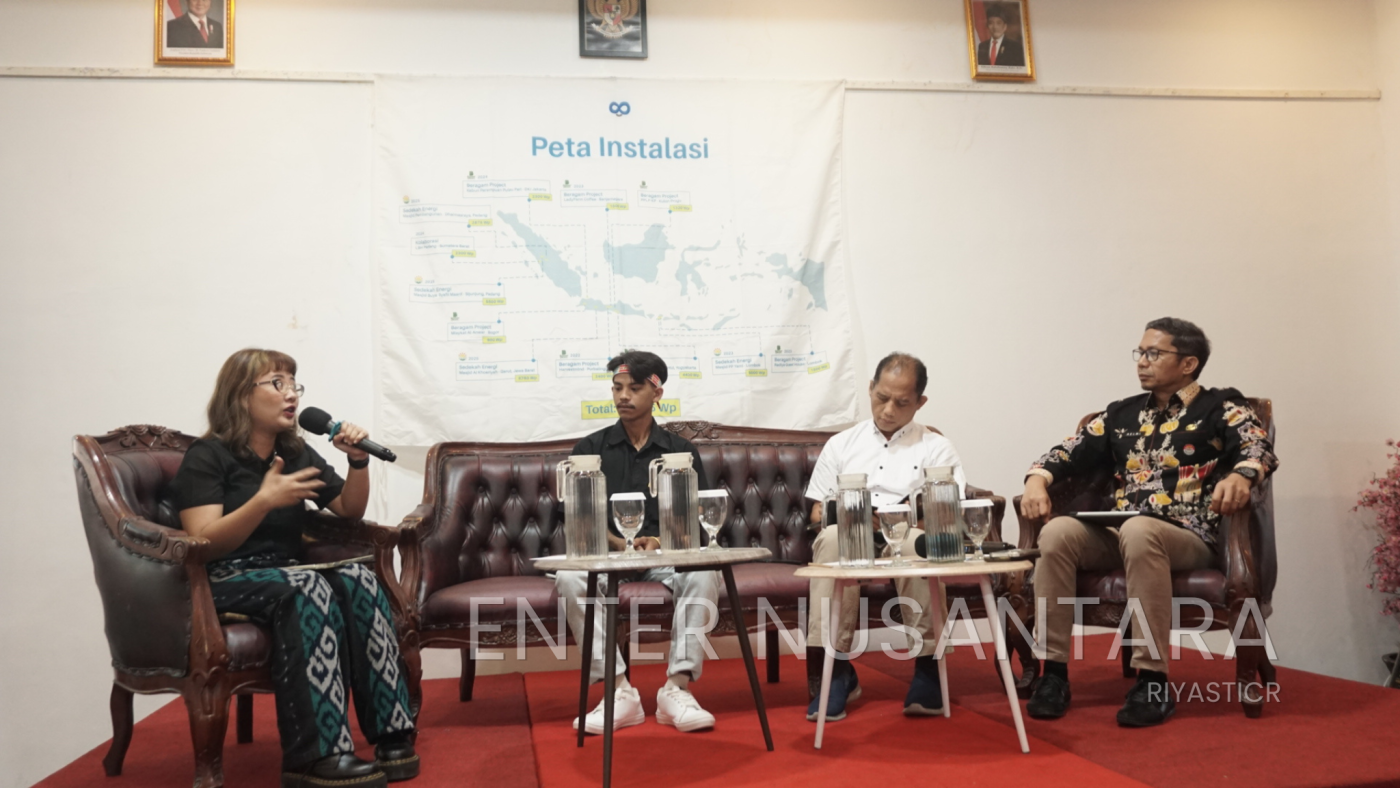
Padang, 2026 — Efforts to drive a just energy transition in Indonesia’s frontier, outermost, and least developed regions (3T) continue to gain momentum. One of the latest initiatives comes from Enter Nusantara through a research dissemination event titled “Synergy for a Just Energy Transition: Dissemination of Research Results and Enter Nusantara’s Solar Power (PLTS) Installation in Mentawai,” held at Favehotel Padang, West Sumatra, on April 23, 2026.
This event served as a platform to share field research findings and reflect on the implementation of the Energy School program, which took place from October to November 2025 in the Mentawai Islands. The program focused on building the capacity of local youth to understand and manage Solar Power Plant (PLTS) technology.
During the presentation, Enter Nusantara researcher Gianluigi Grimaldi Maliyar, alongside Renewable Energy Technician Rizky Ahmad Fauzi, emphasized that a community-based energy approach is key to ensuring program sustainability in regions like Mentawai. Based on research findings, solar energy is considered more adaptive compared to previous biomass projects that failed to operate optimally.
The discussion involved various stakeholders, ranging from non-governmental organizations and local government representatives to community members. Ignasius, a representative of Mentawai youth and a graduate of the Energy School program, stood as a prime example of how local capacity building can directly contribute to the sustainability of energy infrastructure.
Meanwhile, the West Sumatra Department of Energy and Mineral Resources (ESDM), through its Head, Helmi Heriyanto, acknowledged the challenges in knowledge transfer to the public and opened the door for the younger generation to propose more effective management schemes. The ESDM Department also offered the option of a Joint Operation (KSO) with the state electricity company (PLN) as a strategic step to guarantee certainty and standardized electricity tariffs for the community.
Rifai Lubis, a representative from the civil society organization Yayasan Citra Mandiri Mentawai, highlighted the dilemmas faced by the Mentawai people, who sit at the crossroads of energy needs and the protection of indigenous rights.
“Energy development cannot be detached from the social, cultural, and living space context of the local community. If we speak of participation, those who must be engaged in dialogue are the people directly affected, not just administrative representatives,” he stated.
During the forum, Enter Nusantara also outlined follow-up plans, including the rejuvenation of PLTS infrastructure in Matotonan Village, which is now over a decade old and requires upgrading. Furthermore, there are ongoing efforts to expand clean energy access to remote hamlets using community-based management models.
These steps are part of a broader effort to address the dependency on diesel-based energy, which is vulnerable to price fluctuations and distribution hurdles. Amid the push toward national renewable energy targets, a community-based approach is seen as a solution that is not only technically sustainable but also in harmony with local livelihoods.
Furthermore, Enter Nusantara is urging the government to ensure the fulfillment of community land rights through fair and transparent processes. This must be accompanied by sustainable knowledge transfer. This is crucial so that the people of Mentawai are not merely objects of development, but empowered subjects capable of managing their energy sources independently.
Through this dissemination, the research findings serve not only as academic documentation but as a foundation for cross-sector collaboration to realize an inclusive and just energy transition in Indonesia.
