


For decades, Papua has been treated not as homeland, but as a warehouse of resources for Jakarta. Ironically distant enough to be ignored, yet close enough to be continuously exploited. And for just as long, Papuans have resisted in countless ways, yet the cycle continues.
Red crosses has been one of the resistance symbol for the indigenous Papuans. Today, around 1800 red crosses has been placed by local communities as a way to stop destruction of their homeland. Through these red crosses, indigenous Papuans seek help from God and their ancestors to protect their forest, their land, and their entire way of life from being turned into profit that benefits everyone but them.
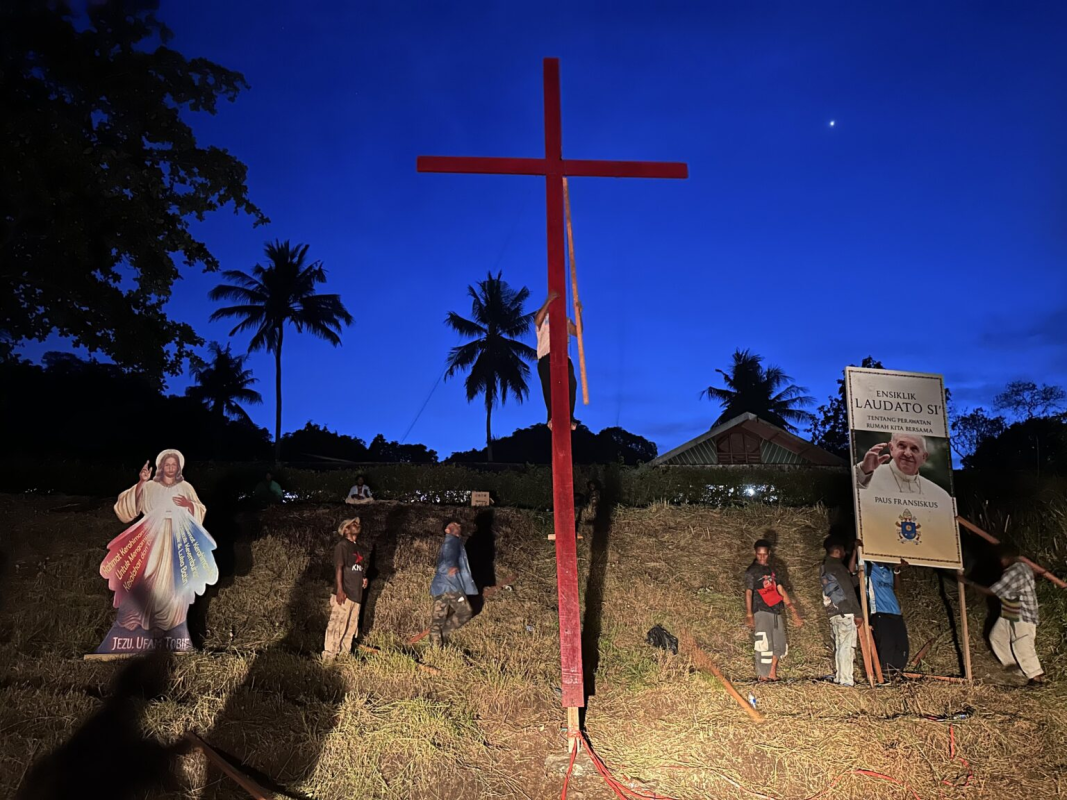
Red Cross standing with Laudato Si’ poster.
Source: @cypripajudale (Twitter)
But the reality is, these greedy people fear neither God nor the ancestors. They see themselves as too powerful to fear anything except the loss of their profits. Thousands and thousands of excavators continues to invade these customary lands. In the name the so-called national interest; development, energy security, food security, and economical growth, they continue to destroy what has been home to Indigenous communities and wildlife for thousands of year.
This modern day colonialism that has been happening in Papua is summarized through the movie “Pig Feast.” It portrays a perpetuated colonialism that continues to be sustained under different names and justifications. Masterplan Percepatan dan Perluasan Pembangunan Ekonomi Indonesia (MP3EI), Merauke Integrated Food and Energy (MIFEE), Food Estate, The so-called energy estate to produce bioethanol from sugarcane and biosolar from palm oil, the names continue to evolve, but they all lead to the same reality: the continuation of colonialism through land grabbing, forest destructions, displacing Indigenous communities from their own lands, and taking away the culture and livelihoods that have sustained them for generations.
Colonialism, something we’ve fought against for centuries until we finally declared our independence. Yet even now, we barely understand what colonialism truly means. Despite knowing what it feels like to be oppressed, we continue to do it to our own people.
Theoretically, colonialism generally understood as the domination by foreign countries. But in reality, it can also be imposed by domestic power through land domination, displacement, and exploitation carried out by the government against our own communities, just like what is happening in Papua.
What is perhaps most concerning is that, this colonialism is being repackaged as a “green” energy transition. When energy colonialism is widely understood by the relations between global north and global south in energy transition–resources extraction in global south to sustain the Electric Vehicles (EV) transition in the Global North, carbon projects in Global South to pay off the Global North ecological debt–, the same colonical logic also operates at the domestic level.
Energy colonialism manifest through systems that reproduce colonial notions: land domination and acquisition, forced displacement, and the concentration of benefits in the hands of the state and corporations while affected communities bear the costs. These colonial patterns are reflected across Indonesia’s energy system, from coal and nickel mining to geothermal development. Yet in Papua, these patterns intensify through a way larger scale land clearing and the militarization surrounding these “development projects” that become a tool to suppress Indigenous people.
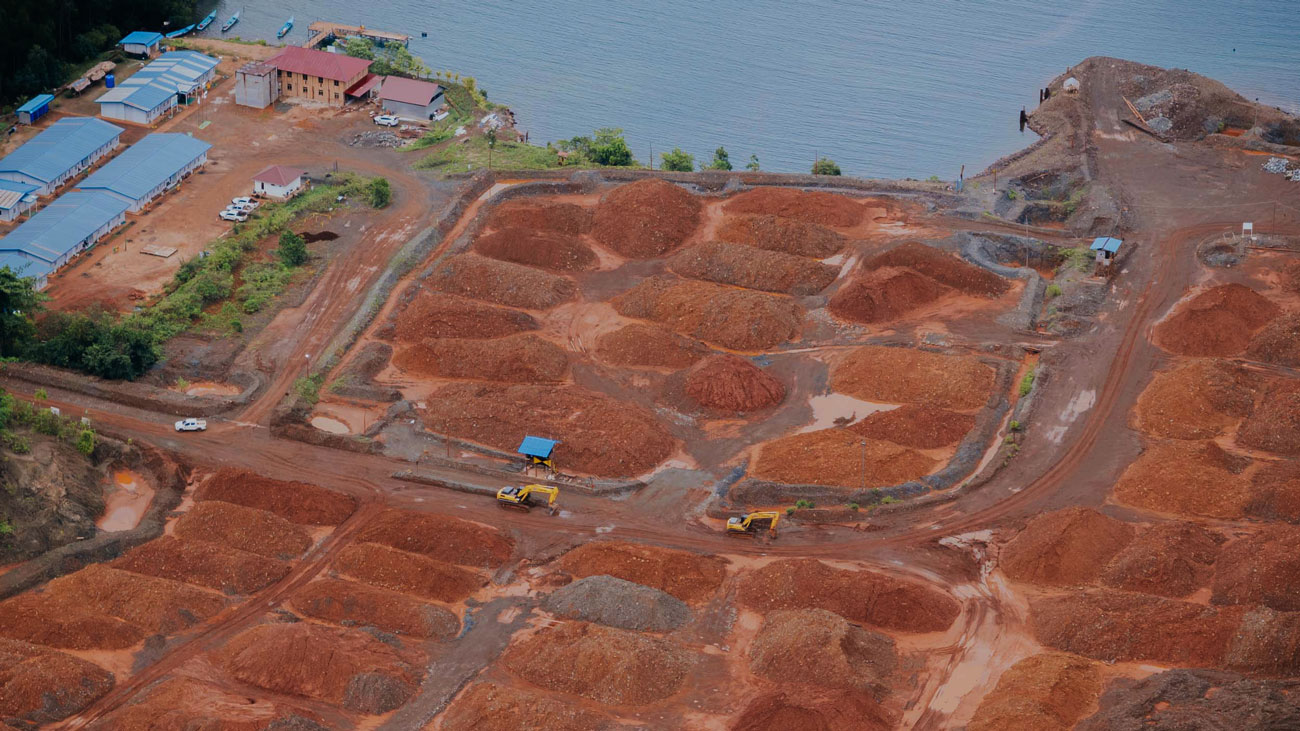
Nickel mining by PT Kawei Sejahtera Mining on Kawe Island, West Waigeo District, Raja Ampat, Southwest Papua.
Source: Greenpeace/ Alif R Nouddy Korua
A just energy transition is supposed to be a collective pathway toward an energy system that is truly sustainable and centered on people’s well being. Yet these practices remain far from the meaning of “just”. Biofuel projects built on sugarcane and palm oil plantations are massively framed as green solutions, while in practice, these “green solutions” prolong dependence on exploitative energy systems, and drive massive deforestation.
The consequences are not only ecological. Beyond the loss of biodiversity and carbon sinks, forests in Papua are inseparable from the lives of Indigenous communities who have long depended on them for food, shelter, medicine, and livelihood. As many Papuans describe it, the forest is their “supermarket”, the foundation of everyday life and survival.
Thus, when the existing energy system continues to operate through colonial patterns, the answer lies not in greener extraction, but in transforming the system altogether. To decentralize is to decolonize. Building a decentralized, community-based energy systems, whether self-sufficient or supported by the state, where energy infrastructure is shaped around the needs, realities, and ways of life of the communities most directly affected by it.
Energy system should not become another tool for extraction, displacement, or corporate accumulation. Instead, it should function as a collective resource that supports people’s livelihoods, autonomy, and relationship with the land.
Bibliography:
- Müller, Franziska (2024). Energy Colonialism. Journal of Political Ecology 31(1). 701–717. doi: https://doi.org/10.2458/jpe.5659
- Kohn, Margaret and Kavita Reddy (2024). Colonialism. The Stanford Encyclopedia of Philosophy. plato.stanford.edu/archives/sum2024/entries/colonialism.
- Desta (2026). Neocolonialism, Postcolonialism and Decolonialism. https://www.dekolonialestadtfuehrung.de/en/2024/12/neocolonialism-postcolonialism-and-decolonialism/.
