

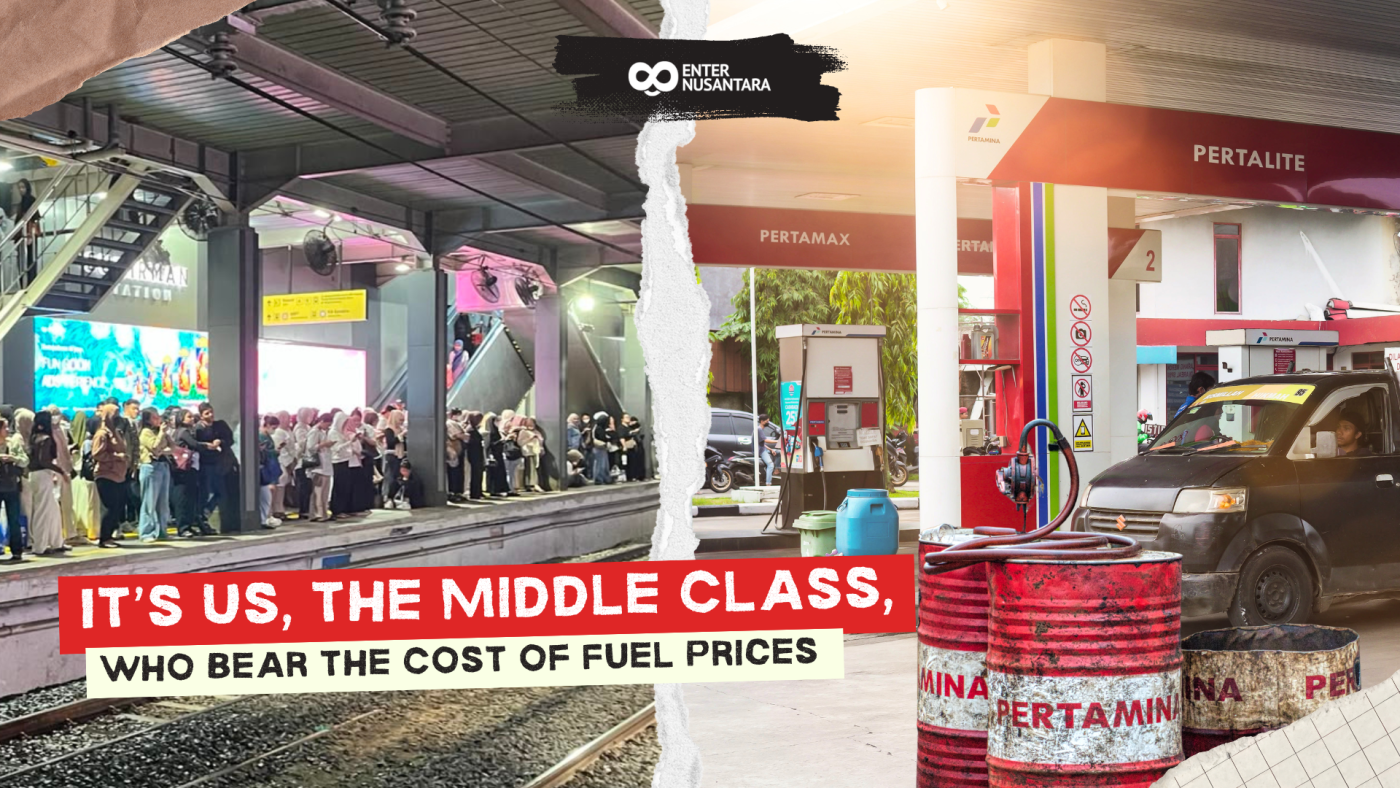
Our future is getting more expensive. One job no longer feels enough to buy a home, build savings, or create financial stability, owning a house is strategic location feels unrealistic unless you’re already wealthy, owning a car need frugal living. We are told to earn more and spend less just to survive. These are the reality for us workers and young people in Indonesia. We work more, yet own less.
“If Gen Z stopped buying coffee, maybe they could afford a house.”
“Young people can’t afford cars because they don’t know how to prioritize their spending.”
Young people hear this advice all the time. We’re told to be financially responsible. But no amount of skipping coffee can keep up with the rising cost of living.
While wages barely could keep up, the cost of housing, transportation, and daily necessities continues to rise. Over the past few months, Indonesians have also been hit by a weakening rupiah and oil shortage. Unfortunately, the government responded the crisis with raising fuel prices instead of making the wealthy pay more, worsening the already high cost life we’re paying.
A weakening rupiah means Indonesia has to pay more for imported goods. While the country still relies heavily on imports for essential needs such as food and oil, higher import costs can quickly affect prices and the cost of living. At the same time, geopolitical conflict has affected global oil supplies and pushed energy prices higher. Since Indonesia still relies heavily on oil for transportation, these price shocks created double burden for the country.
Amid these two pressures, Indonesia is now also facing a third challenge: the costly free meal program. With pressure coming from all sides, the government now has to find more money to keep the economy and its free meal program running.
The government decided to raise the non-subsidized fuel price. At first, it might not seem like it would significantly affect the economy. Or at least, that’s how the government framed it when they announce the fuel price increase. But if we look closer, non-subsidized fuel has long helped sustain the middle-class livelihood.
The rise in non-subsidized fuel prices may not directly affect public transportation and the logistics sector, which still largely rely on subsidized fuel. But for many middle-class Indonesians, it means spending more money just to get around.
The problem is that the impact doesn’t stop at the fuel station. But the people’s purchasing power declines, creating a domino effect across the economy. Pushing people into a more vulnerable economic conditions, rising risk of layoffs as consumption slows down, it could also lead to higher prices for other goods and services over time.
The rise in non-subsidized fuel prices should not be seen as just a one-time policy. It is part of a broader pattern where the middle class is repeatedly asked to make sacrifices and absorb the impact of economic pressures. As prices keep rising, we are told to cut back on spending and simply adapt. Yet the burden of adjustment falls disproportionately on the middle class, while those with the bigger capacity to bear the costs are often the least affected.
Perhaps the most frustrating part is that the middle class is not only expected to absorb the consequences of a failing system we did not create, but also made to uphold a system that continues to squeeze us on all sides.
Relying on a single energy source makes the whole system vulnerable to change. When the main source gets distrupted, it will instantly affect not only mobility but also economy and daily activity. When a country relies too much on oil for transportation, any disruption in oil supply can cause instability. The same goes for electricity. If a country depends heavily on coal to generate power, disruptions in coal supply can affect electricity access and slow down economic activity. A system that depends only on fossil fuels is basically prone to this kind of instability. When things go wrong, it is once again the middle class who are expected to absorb the shock.
Unfortunately for us, the system continues to be maintained without any real structural change. The government keeps choosing to uphold a system that favors fossil fuel dependence, a cycle that keeps repeating itself: instability leads to higher costs, and those costs are pushed onto the middle class to uphold that same insatiable system running.
Behind the deadly loop that keeps trapping the middle class, we need to look deeper at who actually benefits from fossil fuel dependence. The answer is clearly not the middle class, nor the majority of people who bear its consequences, but rather those who never really have to carry the burden of a failing system they continue to benefit from.
This is why many of us in the middle class often feel like we’re stuck in place. Without realizing it, our hard work keeps getting absorbed into maintaining a system that continues to extract more from us than it gives back.
One way to break out of this cycle is through an energy transition and a move away from dependence on a single energy source. Decentralizing the energy system is one concrete step toward breaking this cycle and reducing the structural burden that keeps falling on the middle class.
