

When it comes to energy in Indonesia, let’s be real—our country is incredibly rich. The issue isn’t whether we have energy sources or not, but rather which ones we actually choose to use. Yesterday, we already talked about the energy sources Indonesia owns and utilizes.
To give you a quick recap, we are still heavily dependent on fossil fuels like coal, which makes the pollution even worse. Ironically, public and industrial interest in shifting towards clean energy—like rooftop solar power systems (PLTS)—is currently at an all-time high because the weather is getting more extreme and scorching hot!
But unfortunately, right in the middle of this clean energy enthusiasm, PLN rolled out a regional grid quota regulation. It makes the licensing for certain systems quite a hassle and forces people to queue up—honestly, it feels just like trying to buy music festival tickets.
But don’t worry. If you’re the type who hates relying on fossil fuels and wants to start being energy independent, understanding renewable energy technology is a super smart first step. This time, let’s start with the simplest form of renewable energy. Are you ready? xixixi
Meet the Sunlight Catcher
Simple doesn’t mean basic; this renewable energy captures the ultimate light source of our planet. Say hello to Solar Power Systems (PLTS)!

Simply put, PLTS is a system used to generate electricity from the sun. It consists of several solar panels connected to a system that can convert the electrical current so it can be used in homes or buildings. Wait, does that mean PLTS and Solar Panels are different?
They are different, but the same!
To help you visualize it, let’s use an analogy…
So, the solar panel itself is the device that captures the radiation and light from the sun, then converts it into electrical energy that you can use to charge your phone, turn on the AC, or power your fridge.
Now, why did I say this is the simplest renewable energy? Because installing this generator is incredibly flexible. You can install it on the roof of a house or an office building (rooftop solar), on a large vacant lot, on top of a camper van for those who love traveling, or even floating on lakes and reservoirs.
As long as the spot gets direct sunlight without being blocked by tree shadows or other buildings, you can use it as your personal electricity field. Simple but cool, right?
Now, Let’s Meet the Solar Panel’s Squad
A solar panel can’t work all by itself without help from its “squad.” Inside this system, there’s a big box called an inverter. Just think of this inverter as a “language translator.”
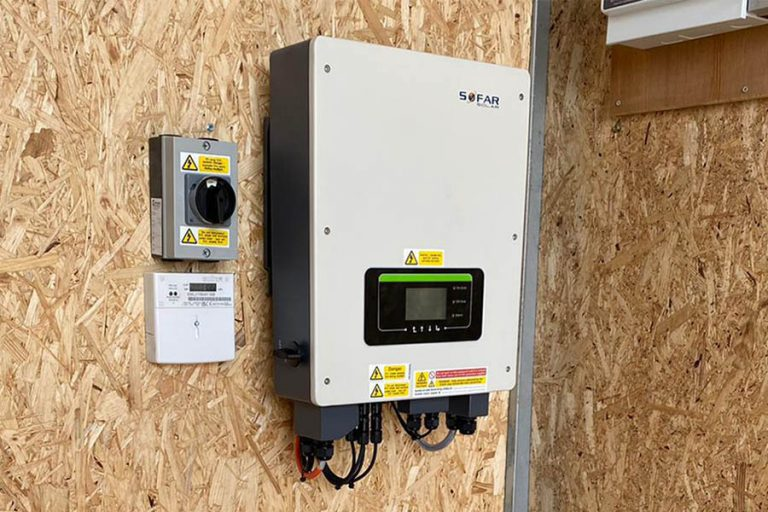
Solar Inverters
Source by Deegesolar.co
The electricity generated by solar panels speaks “DC Language” (Direct Current), while the electronics in your house only understand “AC Language” (Alternating Current). So, this inverter does the translating so your home appliances, like fans and ACs, don’t get confused and blow up when plugged in.
Speaking of electric currents, what’s the difference between DC and AC?
- DC (Direct Current): An electric current that flows in one direction. It’s usually marked by red and black plus-minus cables. All the systems with adapter and battery usually use DC, like handphones, laptop and remote TV.
- AC (Alternating Current): An electric current that changes direction periodically. This is the type of electricity flowing through our home. It’s usually marked by cable colors other than the DC.
Got it? Hope so! Moving on~
Aside from the inverter, there’s the battery, which happens to be the most expensive component. Its job is top-tier: acting as a “bank” to store backup electricity. This ensures you can still binge-watch Netflix at night or during a massive blackout, like the one in Sumatra recently.
Now, to make sure this battery lasts a long time, there’s a device called a Solar Charge Controller (SCC) or Maximum Power Point Tracking (MPPT). Well, with “controller” and “tracking” in the name, you can guess what it does, right? Think of it as the battery’s “traffic cop” or “diet manager,” making sure your battery is charged with just the right portion. So, there’s no such thing as an overcharged battery—because that would be scary, moms!
BTW, for large-scale systems, the inverter usually comes with a built-in MPPT, but for small-scale setups, you’ll still need an additional SCC.
System safety is also heavily guarded by supporting components. There’s the Miniature Circuit Breaker (MCB), which cuts off the current during a short circuit—very similar to the main switch or breaker box at home. Then there’s the Arrester or Surge Protection Device (SPD), which acts as a lightning rod so your investment doesn’t get fried during bad weather.
Lastly, there’s the Automatic Transfer Switch (ATS), which seamlessly shifts the electricity line from the panels to PLN or vice versa without any lag. So when PLN’s power goes out, your house stays bright as day without you having to grope around looking for candles. But remember, this device is only attached to Hybrid systems.
Dizzy yet?
If you already know and memorize the solar panel’s squadt, you can start hunting for solar panels in the market.
But wait, don’t get confused! In the market, you will often run into two of the most popular solar panel camps. Even though both use silicon as their base material to absorb solar energy, their status and manufacturing processes are in completely different leagues:
Camp 1: Polycrystalline (Poly)
This panel sports a blue look. Coarsely putting it, Poly is made from leftover scraps or melted-down silicon pieces. That’s why the price is super budget-friendly, but yeah, the efficiency is just standard—aka pretty basic.
Camp 2: Monocrystalline (Mono)
This panel has an elegant, jet-black appearance. Mono is crafted from premium, pure silicon cuts—not from leftover parts or random crumbs (just kidding).
That’s why if you ask the pros, they will definitely recommend you go with this black Mono type.
Price-wise, it might make your wallet shake a bit because it’s more expensive, but its efficiency is incredibly high and it works optimally when the sun is at its hottest.
So if your goal is top performance and a long-term investment, price shouldn’t be an issue, right? The important thing is efficiency and optimality—we can worry about the money later (as long as the funds are there)!
So, how is it? Do you get the gist of solar panels so far?
But please, don’t get FOMO and just blindly buy them! You still need to calculate your home’s battery “ammunition” so you don’t go broke, determine which way the panels should face so you don’t get a dud setup, and know the differences between On-Grid, Off-Grid, and Hybrid so you don’t get scolded by outdated regulations.
Which topic are you most curious to discuss first in the next part? Let me know in the comments section, and don’t miss out on the next part of bilikbelajar! See you!
