


Every year, September 24 is celebrated as National Farmers’ Day. This commemoration stems from a historic moment during the administration of President Soekarno, when the legal basis for land ownership for the people, especially farmers was passed. This moment became an important milestone in the struggle of farmers in Indonesia, a struggle for justice and prosperity.
We commemorate National Farmers’ Day as the day on which the 1960 Basic Agrarian Law (UUPA) was passed as a milestone of hope for genuine agrarian reform in Indonesia. The UUPA was born out of pressure from the people, especially farmers, who demanded justice in land ownership after centuries of being deprived by colonial and feudal forces.
However, more than six decades later, this ideal remains far from reality and the people’s hopes. Instead of implementing genuine agrarian reform, the state has perpetuated agrarian inequality. Land is controlled by a handful of corporations, whether in plantations, forestry, or mining sectors. Meanwhile, farmers continue to be marginalized, villages sacrificed, and the oligarchy grows more powerful every day.
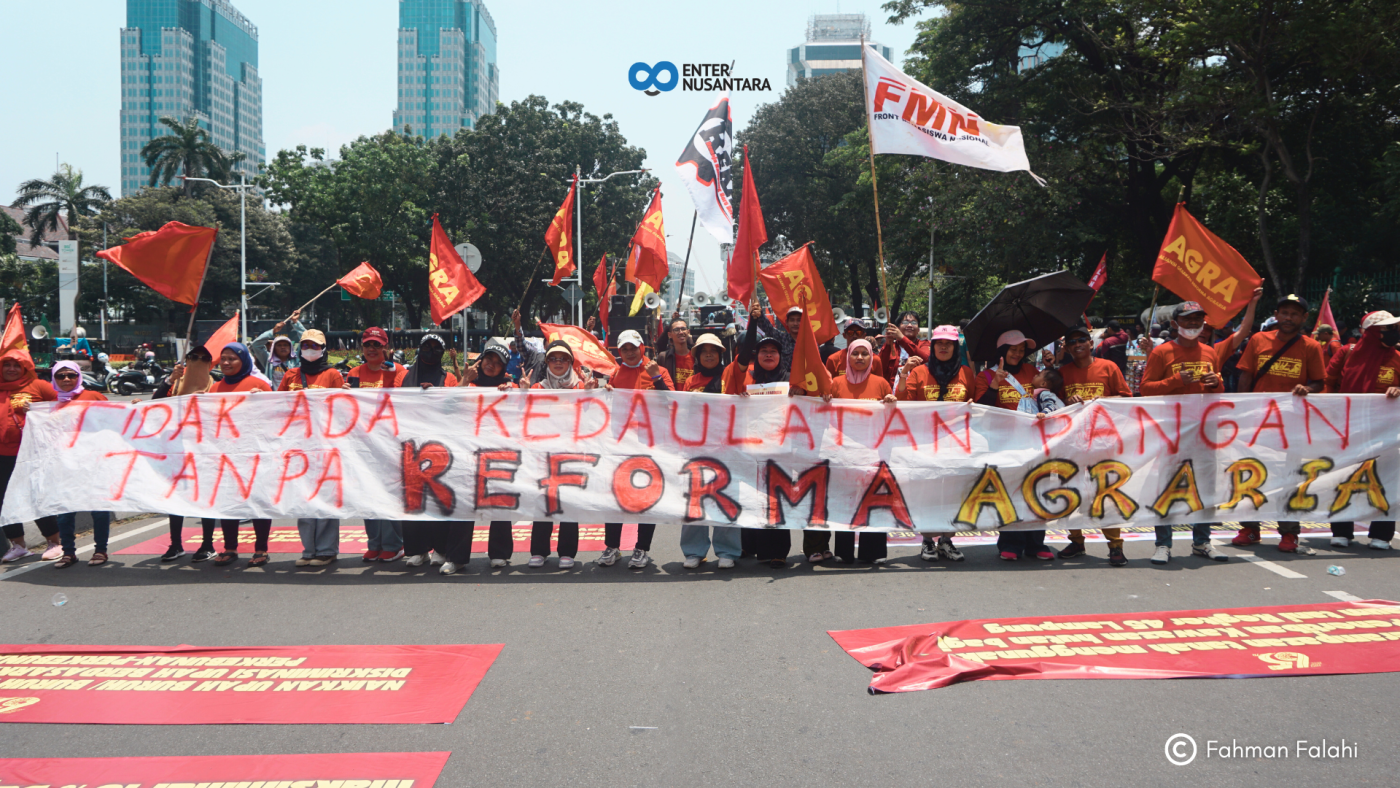
History records that the idea of genuine agrarian reform is not merely a matter of land distribution but of social transformation. The goal is obvious: to dismantle the oppressive structures of feudalism and agrarian capitalism while placing land as a means of production for the people, not merely a commodity to be bought and sold.
However, to this day, the discourse on genuine agrarian reform is stigmatized, silenced, and even labeled subversive. In fact, without genuine agrarian reform, it is impossible to achieve social justice for all people. As a result, agrarian conflicts continue to rage, with more and more farmers being evicted from their land, indigenous peoples losing their forests, fishermen losing their coastlines, and the urban poor being marginalized from their living spaces.
Therefore, on Farmers’ Day, the Indonesian Farmers Union (SPI) held demonstrations in several regions. They presented six demands.
In addition to striving for genuine agrarian reform, SPI presented six demands to the Prabowo Subianto administration. First, they asked the president to immediately resolve agrarian conflicts in Indonesia, whether experienced by SPI members or other farmers. SPI also asked the president to immediately stop the violence and intimidation experienced by farmers.
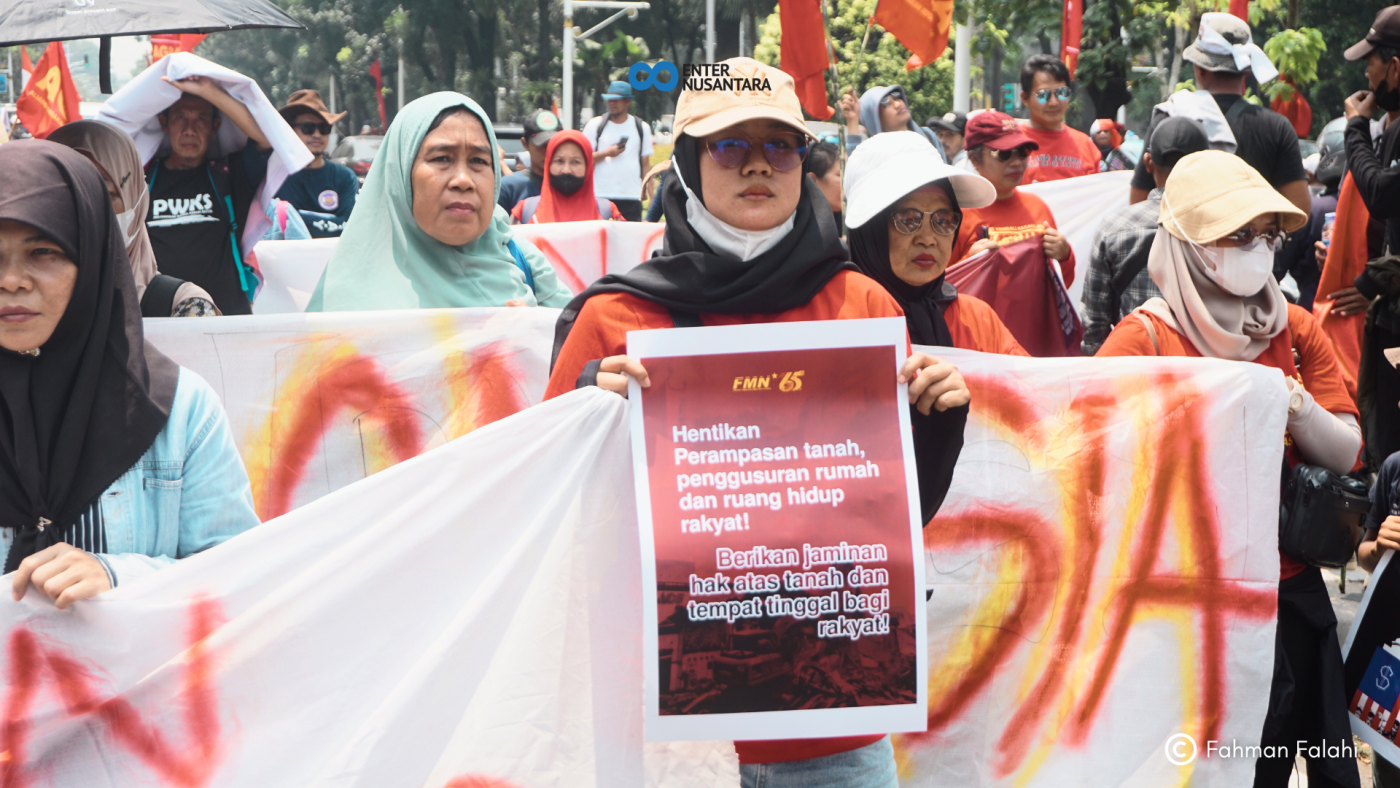
Second, they asked the president to distribute land subject to agrarian reform originating from plantations and forests to farmers. Then, the Forest Area Control Task Force should not take land controlled by farmers.
Third, they asked Prabowo to revise Presidential Regulation 62/2023 on the acceleration of agrarian reform so that it is in line with government regulations and can be implemented effectively.
Fourth, they asked him to revise the Food Law to enforce food sovereignty and reduce dependence on imports, as well as to revise the Forestry Law to ensure agrarian reform guarantees land for farmers and indigenous peoples.
Fifth, immediately revoke the Job Creation Law (Omnibus Law) because it cannot create jobs properly but instead triggers food imports and the seizure of farmers’ land by large corporations.
Sixth, immediately form a National Agrarian Reform Council so that government programs, including free nutritious meals and the Merah Putih Village cooperative, can truly side with farmers.
Farmers’ Day is not just a ceremony; it is a form of resistance. As long as farmers continue to be oppressed, as long as land is treated as a commodity by large corporations, and as long as villages are sacrificed for the interests of investors, this resistance will not stop.
