

Long lines of vehicles snake around fuel stations across Indonesia. People ask each other whether supplies are still available. Some choose to fill their tanks to the brim, fearing that fuel may run out the next day. At nearly the same time, the government repeatedly assures the public that national energy stocks are “secure.”
This contradiction is not new. Fuel and subsidized LPG shortages have occurred time and again, triggering anxiety and panic buying. What appears on the surface as a logistical disruption is, in fact, a symptom of something deeper: a structurally fragile energy system that remains heavily dependent on external forces.
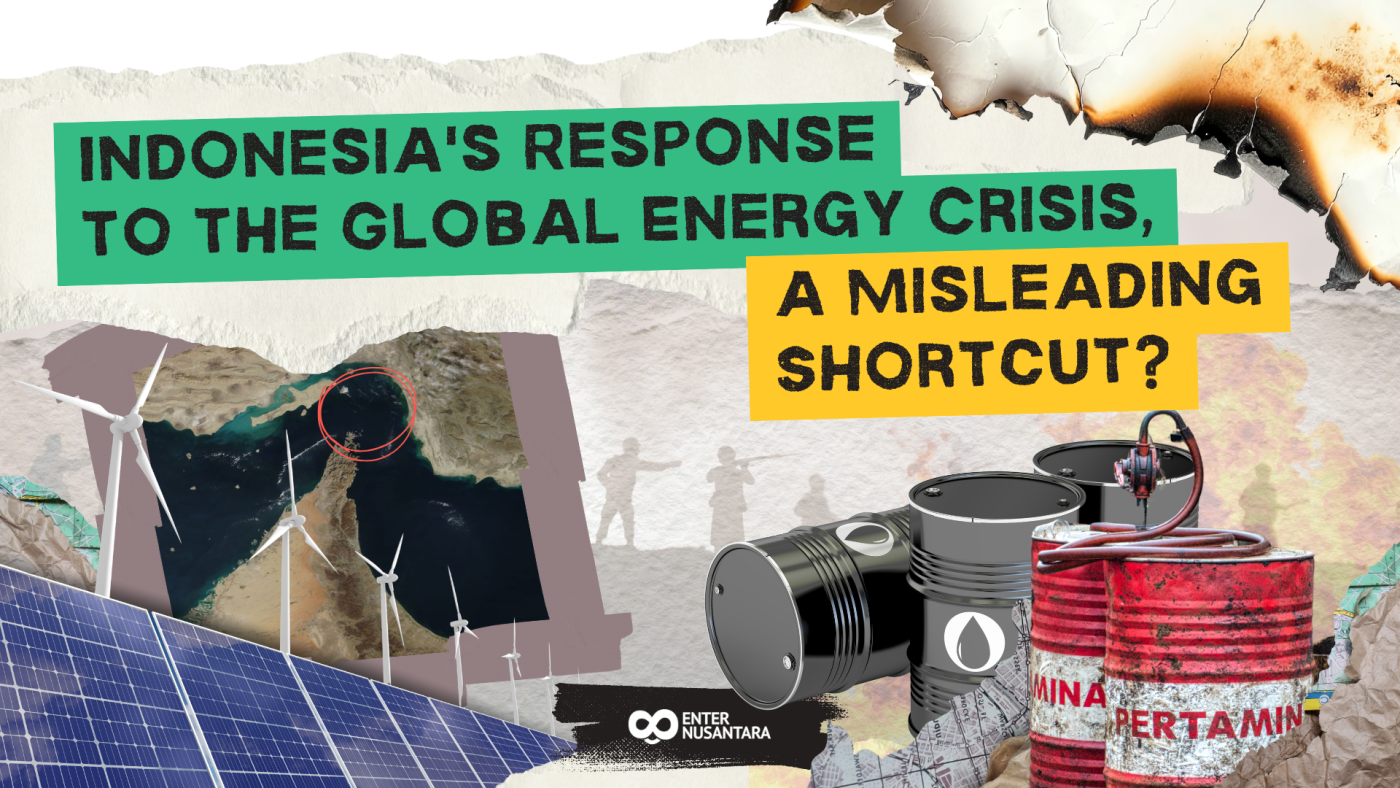
Since early 2026, escalating tensions between the United States and Iran have once again shaken global energy markets. Instability in the Strait of Hormuz, through which around 20 percent of the world’s oil supply passes, has sent ripples across Asia, the primary destination for nearly 90 percent of shipments through the route. For countries like Indonesia, the impact is immediate.
Visual by Dian/EnterNusantara
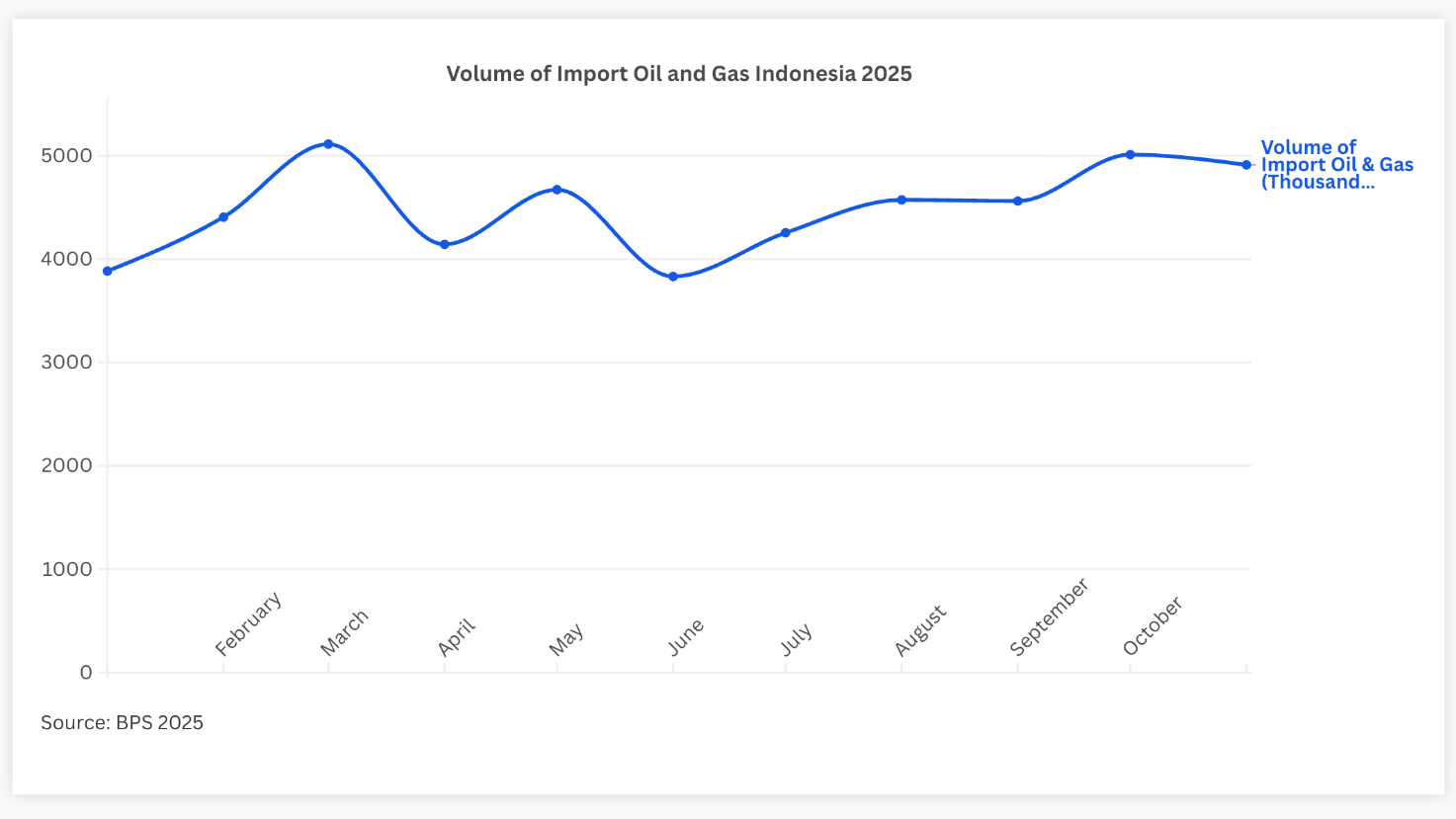
As a net oil importer, Indonesia consumes around 1.7 million barrels of oil per day, while producing only about half of that. This gap has long been filled by imports, effectively tying domestic stability to global volatility. When prices surge or supply chains falter, the consequences are quickly felt, not only in state finances through swelling subsidies, but also in the daily lives of citizens.
The fuel queues, then, are not an anomaly. They are a warning.
And this isn’t new. But a reminder: Indonesia’s energy system is still highly dependent, and easily shaken.
A Crisis That’s Framed Too Narrowly
In response, the government has introduced a range of measures: accelerating biofuel blending (B50), expanding renewable energy capacity, promoting electric vehicles, and urging citizens to conserve energy, through reduced consumption and even work-from-home policies.
On paper, this looks like a full package. But if we take a closer look, something feels off.
First, the crisis is framed as an issue of individual behavior. Public messaging emphasizes energy-saving habits, turning off electricity, reducing fuel use, limiting daily consumption. While important, this approach shifts responsibility away from systemic inefficiencies in infrastructure, industrial consumption, and policy design.
Second, when structural interventions are introduced, they tend to favor large-scale, top-down solutions, most notably, the expansion of biofuels.
This is where the contradiction starts to show. Because while biofuel is framed as a solution, it might actually create a new set of problems. Is Indonesia addressing the root causes of its energy vulnerability, or merely replacing one dependency with another?
Biofuel and the Logic of False Solutions
Biofuel sounds like a good idea at first. Produce energy locally, reduce imports, and support the economy. It feels like a step toward independence.
But the reality is more complicated. One of the biggest concerns is land.
To produce biofuel at scale, Indonesia relies heavily on crops like palm oil. And palm oil expansion has long been linked to deforestation. Between 2000 and 2016, it accounted for around 23 percent of total deforestation in the country.
One hand with data from Nusantara Atlas, in the last 24 years, primary forest loss in the Palm Oil Concessions reached 3.23 million hectares, an area more than six times the size of Bali.
In 2024 alone, primary forest loss in these concessions reached 45,000 hectares, nearly the size of Jakarta. It is important to note that these figures only account for legal, registered concessions; the true scale is likely much higher due to lack of transparency in private data and illegal plantings.

Visual by Dian/EnterNusantara
That’s a huge number. And it shows that this isn’t just about energy, it’s about land use at a massive scale.
It doesn’t stop there. When demand for palm oil increases, it often pushes expansion into forests and peatlands. These areas store enormous amounts of carbon. Once they’re cleared, that carbon is released into the atmosphere.
More critically, biofuel expansion often triggers indirect land-use change (ILUC), where increasing demand for crops like palm oil pushes agricultural expansion into forests and peatlands. These ecosystems store massive amounts of carbon, and their destruction releases what researchers describe as “globally significant” greenhouse gas emissions.
In fact, when ILUC is accounted for, several studies show that palm oil-based biofuels can produce higher lifecycle emissions than fossil diesel.
This creates a paradox: a policy designed to reduce emissions may, in reality, accelerate them.
Peatlands are particularly critical. Indonesia holds around 65 percent of global tropical peat carbon stocks, meaning their degradation has disproportionate climate impacts.
There are also quieter impacts that don’t always make headlines. Large-scale plantations require heavy fertilizer use, which affects soil and water systems. Ecosystems get simplified into monocultures. Biodiversity declines. Research from the University of Indonesia shows that the plantation stage contributes the biggest share of environmental damage in biodiesel production
And then there’s the social side.
Across Indonesia, palm oil expansion has been linked to hundreds of land conflicts, often involving indigenous communities. Forests that used to support livelihoods are converted into industrial land. The benefits tend to be concentrated, while the costs are spread out.
The expansion of oil palm plantations, driven in part by biofuel demand, has been linked to over 700 land conflicts across Indonesia, many involving indigenous communities.
In places like Merauke, where large bioethanol projects are planned, the scale is even bigger. We’re not talking about small adjustments, but major land transformations that could reshape entire ecosystems and communities.
At that point, biofuel is no longer just about energy. It becomes a question of who controls land, who benefits, and who loses.
Expensive, Risky, and Not Really a Solution
From a fiscal perspective, biofuel is not a cheap option. A study by the Center of Economic and Law Studies (CELIOS) estimates that Indonesia could spend more than US$11 billion over the next decade to develop its bioethanol program, almost equal to 89 percent of today’s energy subsidies.

Visual by CELIOS
One major project in Merauke, South Papua, alone could cost nearly US$8 billion, just to open up around 2 million hectares of land.

Visual by CELIOS
In a country where budget space is already tight, this isn’t just a big number, it’s a risky one. Instead of reducing the burden on the state, biofuel could actually create new financial pressure, especially when oil prices remain unstable and the rupiah is still vulnerable.
But the problem doesn’t stop at cost.
To scale up biofuel, large areas of land are needed. And in many cases, that means clearing forests. In places like Merauke, these projects have already been linked to deforestation and growing pressure on local ecosystems.
This has real consequences. Not just for the environment, but for people.
Indigenous communities who depend on forests risk losing their land and livelihoods. When projects are pushed from the top without meaningful involvement from local communities, land conflicts become almost unavoidable.
There’s also another tension that’s hard to ignore: food versus fuel.
Crops like palm oil and sugarcane are being used for energy, but they are also part of the food system. When demand for these crops increases, it can push up food prices, something Indonesia has already experienced before. And when that happens, it’s households that feel the impact first.
On top of that, biofuel in Indonesia is still relatively expensive to produce. Compared to countries like Brazil, which have spent decades building their industry, Indonesia is still catching up. That means biofuel here is likely to rely on subsidies for a long time.
So instead of solving the energy problem, biofuel risks shifting it somewhere else,into state finances, into food systems, and into communities living closest to the land.
If we zoom out, a pattern starts to appear. Biofuel doesn’t really fix the core issue, it just shifts it.
Instead of relying on imported oil, the system starts relying on large-scale land conversion. Instead of global market risks, new risks emerge: environmental damage, land conflict, and long-term costs.
At the same time, the structure of the energy system stays mostly the same, centralized, top-down, and dependent on large projects.
So the question is: are we actually building a more resilient system, or just replacing one vulnerability with another?
There Are Other Paths, They’re Already Here!
What makes this more frustrating is that alternatives already exist.
First, reducing demand through public transport and energy efficiency.
Transport is one of the largest consumers of fuel. Shifting from private vehicles to mass transit can deliver immediate reductions in fuel consumption without requiring large-scale land use.
Second, accelerating electrification.
Electric vehicles, supported by targeted fiscal incentives, have already shown strong uptake in Indonesia. Maintaining and expanding these policies can reduce fossil fuel dependence without introducing new environmental trade-offs.
Third, scaling decentralized renewable energy.
Rooftop solar and community-based energy systems, combined with battery storage, allow energy to be produced close to where it is consumed.
For a country like Indonesia, spread across thousands of islands, this model makes a lot of sense. It’s not just cleaner, but also more resilient. Research by IESR shows it could even lower generation costs by up to 21 percent in a fully renewable scenario. And, it doesn’t require clearing forests or taking over large areas of land.
This approach offers multiple advantages:
- lower transmission losses
- faster deployment
- reduced environmental impact
- increased local resilience
Most importantly, it shifts the energy system from being centralized and extractive to distributed and participatory.
So, What Kind of Transition Are We Talking About?
At the end of the day, this isn’t just about energy. It’s about direction. A crisis like this can push a country to change. But it can also be used to justify decisions that were already planned.
The risk is that urgency becomes an excuse to move faster without asking the right questions.
Are we building an energy system that is fair and resilient? Or one that continues old patterns, just with different resources?
A just energy transition will not emerge automatically. It requires sustained public pressure and collective action.
Several steps can be taken:
- Demand transparency and accountability in large-scale energy projects
- Scrutinize public spending, ensuring it is directed toward sustainable and equitable solutions
- Advocate for decentralized renewable energy systems, including rooftop solar and community-based energy
- Push for stronger public transport and electrification policies
- Amplify the voices of affected communities, particularly in regions facing land conversion
The energy crisis should be a turning point, not a shortcut. Because in every energy decision, the most important question remains: who benefits, and who bears the cost?
